Business Hours: Monday – Saturday, 9:00 AM – 6:00 PM
1800 560 779

Sungrow Home Batteries / Australia

Sungrow Home Batteries in Australia

Store Your Solar Energy. Take Control of Your Home's Energy Use.

Make more of the solar energy your home generates with a Sungrow home battery. Store surplus solar electricity during the day and use that stored energy in the evening or when your household needs it.

At Make My Solar, we help Australian homeowners compare Sungrow residential battery options and understand which capacity and compatible inverter configuration may suit their energy needs. Whether you're adding storage to an existing solar system or planning a new solar and battery installation, we'll help you explore your options.

Get a Sungrow Battery Quote

Personalised battery recommendations based on your home, energy usage and solar setup.

Existing Solar Systems Explore options for adding battery storage to your current setup.
New Solar & Battery Consider your panels, inverter and storage as one system.
Personalised Recommendations Compare suitable options around your energy use and property.
Sungrow Energy Storage Australia

What Is a Sungrow Home Battery?

A Sungrow home battery stores electricity for use when your solar panels are not generating enough power to meet your household's needs, helping you make greater use of the solar energy produced by your own roof.

During the day, your solar panels generate electricity to run your home. When solar production exceeds your immediate household demand, surplus energy charges your battery.

In the evening, your home can use the stored energy to help power appliances. If solar and battery output are insufficient, electricity is still drawn from the grid.

Sungrow offers residential energy storage solutions that combine compatible LFP battery systems, hybrid inverters and monitoring technology. Different battery families, such as the SBR and SBH series, provide different storage capacities and system configurations to suit varied household needs.

Grid Import / Export Grid supplies power when solar and battery are insufficient, and receives surplus exports.
Important: Battery storage capacity, backup capability and compatible inverter options vary by model. Confirm the exact Sungrow battery and inverter configuration for your property against the current Australian datasheet and warranty terms before proceeding.
Explore Sungrow Battery Options

Sungrow SBR & SBH Battery Series

Looking for a Sungrow home battery in Australia? The SBR and SBH high-voltage battery ranges offer different storage capacities for residential solar systems. Understanding their differences can help you narrow down the options for your home.

Both ranges use lithium iron phosphate (LFP) battery technology. The right choice depends on your electricity usage, desired storage capacity, inverter compatibility and how your complete system will be designed.

SBR
Sungrow SBR Series Modular residential storage
6.4–25.6 kWh Nominal capacity
SBH
Sungrow SBH Series Higher-capacity storage
15–40 kWh Nominal capacity
SBR Battery Family
Sungrow SBR high-voltage modular home battery system

Sungrow SBR Series

6.4–25.6 kWh nominal capacity

The Sungrow SBR series is a modular, high-voltage home battery range. Its listed configurations cover several storage sizes, making it worth considering when comparing battery capacity for everyday household energy use.

Key features

  • High-voltage lithium iron phosphate (LFP) battery chemistry.
  • Listed battery configurations from 6.4 to 25.6 kWh nominal capacity.
  • Up to 100% usable energy, as specified by Sungrow for the supported range.
  • Modular design with expansion options subject to manufacturer requirements.
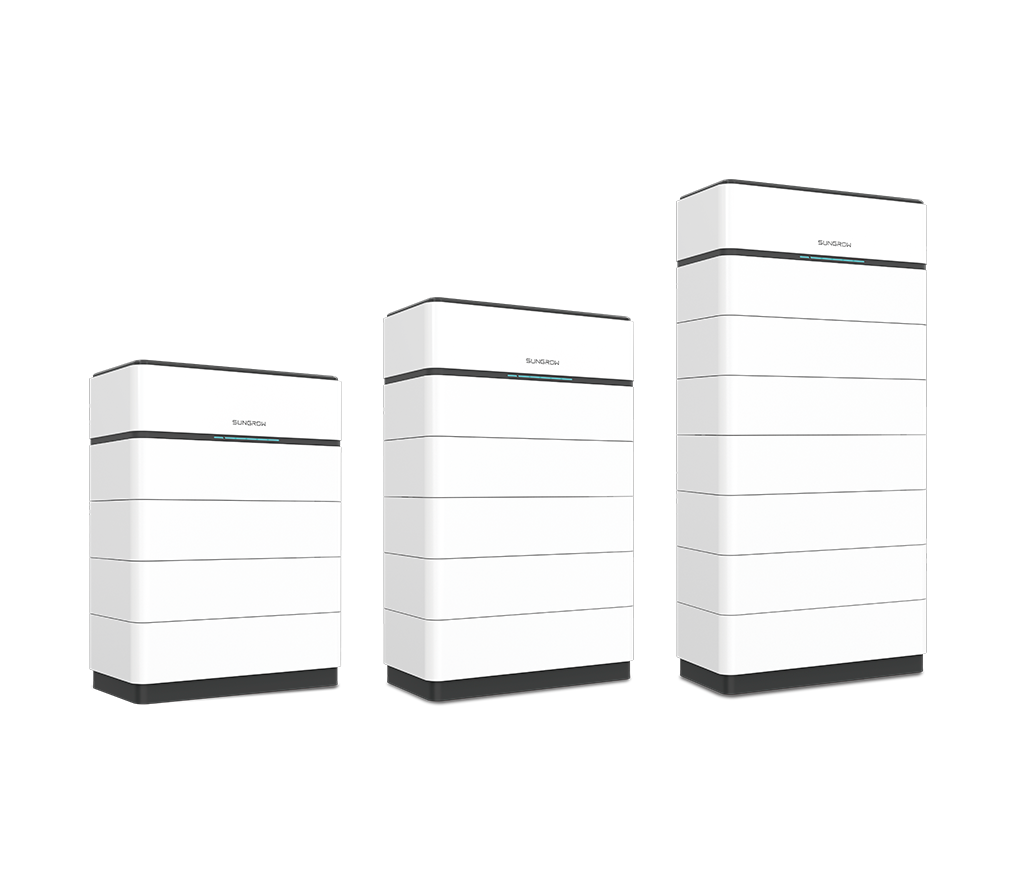
Important: Actual usable energy, charge and discharge limits, expansion options and inverter compatibility depend on the selected model and system configuration.
SBH Battery Family
Sungrow SBH modular high-voltage battery configurations

Sungrow SBH Series

15–40 kWh nominal capacity

The Sungrow SBH series provides higher nominal storage capacities through stackable battery modules. It may suit households that need more stored energy, provided the selected inverter and system design support the required battery configuration.

Key features

  • High-voltage lithium iron phosphate (LFP) battery chemistry.
  • Listed residential battery models from 15 to 40 kWh nominal capacity.
  • Modular, stackable construction with model-specific expansion limits.
  • Designed for supported Sungrow hybrid inverter and storage configurations.
Important: Check the exact SBH model, compatible inverter, installation requirements and permitted system size before selecting a battery configuration.

Sungrow SBR vs SBH: What's the Difference?

Compare the published capacity ranges and key design considerations before deciding which Sungrow home battery to explore.

Feature Sungrow SBR Sungrow SBH
Nominal capacity range 6.4–25.6 kWh 15–40 kWh
Battery chemistry High-voltage lithium iron phosphate (LFP) High-voltage lithium iron phosphate (LFP)
Design Modular battery configurations Stackable modular battery configurations
Best starting point Households comparing a range of residential storage sizes Households exploring higher nominal storage capacities
Inverter compatibility Must be verified for the exact battery and inverter models Must be verified for the exact battery and inverter models
Expansion Subject to model-specific limits and manufacturer requirements Subject to model-specific limits and manufacturer requirements
What to compare Usable energy, power, inverter and installation requirements Usable energy, power, inverter and installation requirements
Choose the Right Configuration

Which Sungrow Battery Is Right for Your Home?

A larger battery is not automatically the better investment. The right capacity depends on how much electricity your household uses after sunset, how much surplus solar energy your panels generate and whether your system needs backup capability.

At Make My Solar, we help you compare suitable Sungrow battery options for a new solar installation or an existing system. The goal is to find a configuration that fits your energy requirements rather than simply choosing the largest battery.

Your evening electricity usage Consider how much power your household needs after solar generation falls, including appliances used overnight.
Your available solar surplus Battery capacity should make sense for the solar energy left over after your home has used what it needs.
Inverter and system compatibility Confirm the supported battery, inverter, phase, operating limits and installation requirements for the complete system.
Backup needs and total installed cost If backup power matters, check the required backup equipment and supported loads as well as the overall installation cost.

Capacity figures shown are nominal capacity ranges published for Sungrow's listed SBR and SBH residential battery families. Usable energy, power output, inverter compatibility, backup functionality, expansion limits and availability depend on the exact model and system design. Product specifications may change. Confirm details against the current official Sungrow Australian product range and relevant datasheets before purchase or installation.

Compare Models & Capacity

Sungrow Battery Specifications & Sizing Guide

Compare Sungrow SBR and SBH home battery models, their published capacity ranges and important system specifications. This guide helps Australian homeowners understand the differences before choosing a battery for a new or existing solar installation.

Battery capacity is only one part of the decision. Usable energy, charging and discharging limits, inverter compatibility and your household's electricity use all influence the right configuration.

SBR capacity range 6.4–25.6 kWh per listed battery unit
SBH capacity range 15–40 kWh per listed battery unit
SBR continuous current Up to 30 A Subject to product specifications
SBH charge/discharge current Up to 50 A Subject to operating conditions

Sungrow SBR Battery Specifications

The SBR064–SBR256 range uses modular 3.2 kWh battery modules. The model numbers correspond to the listed capacity configurations.

SBR Series
Battery model Listed capacity Usable energy in published datasheet Product information
SBR064 6.4 kWh 6.4 kWh Official SBR details ↗
SBR096 9.6 kWh 9.6 kWh Official SBR details ↗
SBR128 12.8 kWh 12.8 kWh Official SBR details ↗
SBR160 16.0 kWh 16.0 kWh Official SBR details ↗
SBR192 19.2 kWh 19.2 kWh Official SBR details ↗
SBR224 22.4 kWh 22.4 kWh Official SBR details ↗
SBR256 25.6 kWh 25.6 kWh Official SBR details ↗

The usable-energy figures above are the values listed in Sungrow's published SBR datasheet. Confirm the latest Australian datasheet and applicable test conditions for the exact model before specifying a system.

Sungrow SBH Battery Specifications

The SBH150–SBH400 range uses 5 kWh modules and offers larger listed storage configurations. The model-specific datasheet should be used to verify energy, power and installation requirements.

SBH Series
Battery model Listed capacity Usable energy in published datasheet Product information
SBH150 15 kWh 15 kWh Official SBH details ↗
SBH200 20 kWh 20 kWh Official SBH details ↗
SBH250 25 kWh 25 kWh Official SBH details ↗
SBH300 30 kWh 30 kWh Official SBH details ↗
SBH350 35 kWh 35 kWh Official SBH details ↗
SBH400 40 kWh 40 kWh Official SBH details ↗

SBH usable-energy values are taken from the published SBH150–SBH400 datasheet. Check the current Australian product documentation for operating conditions, supported inverter combinations and any model-specific limitations.

Plan Your Home Storage

What Size Sungrow Battery Do You Need?

The right Sungrow home battery size depends on how much electricity you use after sunset, how much excess solar your panels generate, your inverter's capability and your budget. Use the guide below as a starting point—not as a substitute for reviewing your energy data.

Smaller storage

For moderate evening use

A smaller configuration may suit homes with moderate after-sunset consumption and enough daytime solar generation to recharge the battery regularly.

Explore SBR models from 6.4 kWh

Mid-range storage

For higher daily usage

A medium-sized system may be worth exploring where evening appliances, cooking, cooling and other household loads increase the amount of energy needed after solar production drops.

Compare suitable SBR or SBH configurations

Larger storage

For greater storage needs

Larger configurations may suit homes with substantial evening demand or future plans for more electricity use. The battery must be chargeable and compatible with the complete system.

Explore SBH models up to 40 kWh

Explore a battery capacity

Move the slider to see which listed model capacities are close to the amount of storage you're considering.

12.8 kWh Selected capacity
Illustrative comparison
Closest listed model capacity SBR128 — 12.8 kWh

This is the closest listed capacity to your selection, not a personalised recommendation.

What to check next Usable energy and inverter match

Check your evening energy use, available solar surplus and supported inverter configuration before choosing a system.

This tool compares your selected number with published model capacities only. It does not calculate your household's ideal battery size, expected savings, backup duration or system output. Those require your actual usage, solar generation and system details.

Product information and specifications: Official Sungrow SBR range  |  Official Sungrow SBH range  |  Sungrow Australia warranty information. Always verify current Australian datasheets before purchase or installation.
Australian Government Incentives

Can You Get a Rebate on a Sungrow Battery in Australia?

Eligible Sungrow home battery installations may qualify for a discount through the Australian Government's Cheaper Home Batteries Program. The incentive is delivered through small-scale technology certificates (STCs), which can reduce the upfront cost of an eligible battery system.

The discount is not a fixed rebate amount for every household. It depends on the eligible battery system, its usable capacity, the applicable STC factor and the program rules in force when the installation is completed and certified.

Indicative program support ~30% Government aims to maintain around this level of upfront discount; actual amounts vary.
Eligible nominal capacity 5–100 kWh Subject to the exact system and all eligibility requirements.
Capacity receiving STCs Up to 50 kWh STCs are calculated on eligible usable capacity, not simply nominal capacity.
Current STC factor 6.8 Per eligible kWh for installations from May to December 2026, before capacity tapering.
01 / How the Discount Is Calculated

STC Support Tapers by Usable Battery Capacity

From 1 May 2026, different STC factors apply to different portions of a battery system's eligible usable capacity. The percentages below show the STC factor applied to each capacity band, not the percentage discount on the purchase price.

0–14 kWh 100%

Full STC factor

The full applicable STC factor applies to the first 14 kWh of eligible usable battery capacity.

Above 14–28 kWh 60%

Reduced STC factor

The 60% factor applies only to the portion of eligible usable capacity in this band.

Above 28–50 kWh 15%

Further reduced factor

The 15% factor applies to the portion of eligible usable capacity in this band. Capacity above 50 kWh does not earn additional STCs.

The STC factor also decreases over time

The factor is determined by the applicable installation and certification timing under the program rules. These published factors show why the estimated incentive can change between the date of a quote and the date of installation.

May–Dec 2026 6.8 CURRENT PERIOD
Jan–Jun 2027 5.7
Jul–Dec 2027 5.2
Jan–Jun 2028 4.6
Jul–Dec 2028 4.1
Jan–Jun 2029 3.6
Jul–Dec 2029 3.1
Jan–Jun 2030 2.6
Jul–Dec 2030 2.1

Important timing note: the applicable STC factor is based on the relevant installation and certification timing, not simply the date you sign a contract. The capacity taper also applies. Ask your installer to confirm the estimated incentive for your planned installation date.

02 / What You Need to Know

Eligibility Requirements for the Sungrow Battery Discount

Eligibility applies to the complete battery installation, not just the brand name. The selected Sungrow battery, compatible inverter, final configuration and installation must meet the current program requirements before an incentive can be claimed.

Battery & System Requirements

  • Eligible system capacity: the complete battery system must meet the program's 5–100 kWh nominal capacity requirements.
  • Approved products: the exact battery and inverter must be listed on the relevant Clean Energy Council (CEC) approved product lists at the required time.
  • Solar connection: the battery must be connected to a new or existing solar PV system, subject to the applicable program requirements.
  • VPP capability for on-grid systems: the system must have the required technical capability to participate in a virtual power plant. Joining a VPP is not itself mandatory.
  • Capacity calculation: STCs are calculated using eligible usable capacity, with support limited to the first 50 kWh of usable capacity.

Installation & Compliance

  • Accredited installer: installation must be completed in accordance with the program requirements by an appropriately accredited Solar Accreditation Australia (SAA) installer.
  • Electrical compliance: the installation must meet applicable Australian electrical safety, battery installation and grid-connection requirements.
  • System commissioning: the battery must be installed, tested and certified in accordance with the applicable rules.
  • Evidence and records: installers must meet applicable documentation, photographic evidence and certificate-claim requirements.
  • Final configuration: stacked modules and the selected inverter must be compatible, and the final system configuration must satisfy current product-list and program requirements.

Does every Sungrow battery automatically qualify?

No. Do not assume every Sungrow SBR or SBH model, inverter pairing or stacked configuration automatically qualifies. Product listings and approvals can change. Before including a discount in a quote, check the exact installed battery model, inverter and complete configuration against the current approved product lists and official program rules.

03 / Plan Your Installation

How Can Make My Solar Help?

We can help you compare suitable Sungrow battery configurations and understand which eligibility checks need to be completed before an incentive is included in your quote. The estimated discount should be confirmed against the applicable program rules and your planned installation date.

Ask About Sungrow Battery Rebates

Information reflects published Australian Government program settings available in October 2026 and is provided as general guidance, not a guarantee of eligibility or a fixed rebate amount. STC factors, capacity tapering, approved products and installation requirements may change. The discount depends on the specific eligible installation and applicable rules. Confirm the current requirements with the Clean Energy Regulator and DCCEEW before making a purchase decision.

YOUR STEP-BY-STEP GUIDE

How to Access Your Sungrow Solar Monitoring

Follow this guide to access your solar and battery information through Sungrow's iSolarCloud app or website. Whether you are registering for the first time or trying to access an existing system, start with the steps below.

✓ Beginner-friendly instructions ✓ Australian account setup ✓ Help if your system is missing
!

Before you begin: is your Sungrow system already installed?

If your solar battery and inverter are already installed and working, you usually only need an iSolarCloud account and access to your existing plant. You do not normally need to set up the inverter again just to view your monitoring information.

FOLLOW THESE STEPS IN ORDER

Get access to your monitoring dashboard

Complete the account steps first, then make sure your installed system is linked to your account.

01
GET THE APP

Download Sungrow iSolarCloud

On your smartphone, open the Apple App Store or Google Play Store and search for iSolarCloud. Install the official Sungrow monitoring app. You can also use the iSolarCloud web portal on a computer or in your phone's browser.

02
CHOOSE YOUR REGION

Select the Australian server

Open iSolarCloud. If the app asks you to change servers, choose the Australian Server. If you do not see this prompt, look for the server selection option on the login screen or in the app settings.

i

Why does this matter? Your account must use the appropriate server for your region. If you already have an account, check its server before creating another account.

03
ACCOUNT SETUP

Register as an End User

If you are a homeowner and do not already have an account, tap Register. Select the End User account type. Sungrow's published guidance includes the following details:

  • 1 Enter your email and request a verification code.
  • 2 Enter the code sent to your email.
  • 3 Create a password and complete your account details.
  • 4 Select Australia as your region and set your time zone.
  • 5 Accept the privacy policy and submit the form.
i

Already registered? Skip registration and sign in to your existing account. Do not create another account simply because your plant is not appearing.

05
VIEW YOUR INFORMATION

Open your dashboard

Once your plant is available, select it to view the information supported by your installation.

☀ Solar generation
▥ Battery status
⌂ Home consumption
⇄ Grid energy
i

Some readings may be unavailable. Consumption and grid readings depend on compatible equipment and metering. An empty reading does not automatically mean your battery is faulty.

ONLY IF YOUR SYSTEM IS OFFLINE

Can't see updated data, or is the inverter offline?

Getting access to an account is different from connecting the inverter to the internet. If your plant is listed but its information is not updating, follow these checks first.

01

Check your home internet

Confirm your home internet is working. If your router or Wi-Fi password has changed, the inverter's communication device may need to be reconfigured.

02

Allow time for data to update

Monitoring information may not update instantly. If the plant was recently connected, allow time for it to report data and check again.

03

Contact your installer

If the plant remains offline, ask your installer to check the communication device, network connection and plant configuration for your inverter model.

!
Do not guess your way through inverter setup.

Initialising an inverter, configuring its Wi-Fi device and changing commissioning settings are not the same as signing into monitoring. Follow the guide for your exact hardware or ask a qualified installer for help.

Open Sungrow's official troubleshooting guides ↗
QUICK HELP

What should you do if something goes wrong?

Find the situation that matches your problem.

I registered, but my solar plant is missing.

Check that you selected the Australian server and signed in to the correct account. If the plant is still missing, ask your installer to share or link the existing plant with your End User account.

My plant is listed, but the data is not updating.

Check the plant's reported status and your internet connection. If the system was recently connected, allow time for data to arrive. If it remains offline, ask your installer to check the communication device and network configuration.

I forgot my password or cannot sign in.

Confirm that you are using the correct server and registered email address. Use the password recovery option on the login screen if necessary. Avoid creating a second account as a workaround.

I want to connect the inverter to Wi-Fi for the first time.

This is a separate device-configuration task. Sungrow publishes different guides for supported communication devices, including WiNet and Wi-Fi modules. Use the guide for your exact hardware or ask your installer to complete the setup.

I cannot see my home's energy use or grid readings.

Some readings require a compatible energy meter and the correct system configuration. Ask your installer to confirm whether your equipment supports the readings you expect to see.

Instructions are a homeowner-friendly summary of Sungrow's published guidance. App labels and procedures may change. The exact setup depends on your account, inverter, communication device and installation.

Personalised Battery Advice

Get Your Sungrow Battery Quote

Tell us about your home and energy needs. Our team will help you explore a suitable Sungrow SBH or SBR battery configuration.

01 Your contact details
02 Your energy setup
Do you already have solar? *
03 Your preferences
Quarterly electricity bill *
Preferred battery capacity *
Backup power during outages? *
Scroll to Top